The steak came out well done when the guest asked for medium rare. The food took forty minutes. The soup is cold. Every restaurant has nights like that.
The problem isn’t what decides whether that guest comes back. What the server does next decides it. Handled well, a complaint can turn into a guest who trusts you more than before. Handled badly, it turns into a one-star review and a table you never see again.
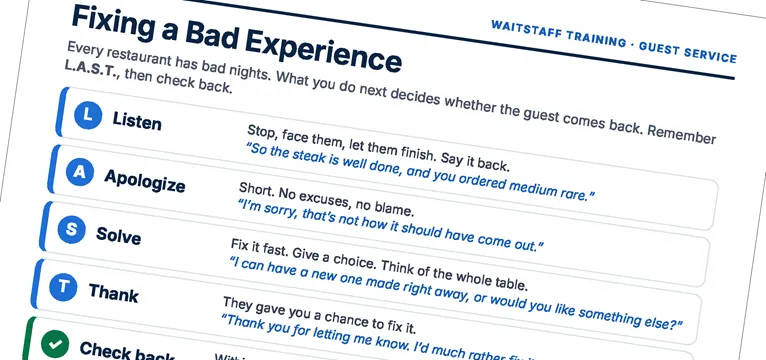
The National Restaurant Association teaches a four-step method servers can remember under pressure: L.A.S.T. Listen, Apologize, Solve, Thank. Then one more step that most restaurants forget: check back.
L: Listen
Stop what you’re doing, face the guest and let them finish. Don’t interrupt, don’t explain, don’t start fixing before you know the whole problem. Eye contact, lean in a little, nod.
If you need to, repeat it back: “So the steak is well done, and you ordered it medium rare.” The guest knows you heard them, and you know exactly what to fix.
A: Apologize
A real apology is short and doesn’t make excuses: “I’m sorry, that’s not how it should have come out.”
What not to say:
- “The kitchen is really slammed tonight.” The guest doesn’t care whose fault it is.
- “That’s how it usually comes.” You’re telling them they’re wrong.
- “Nobody else has complained.” Now it’s an argument.
You’re not admitting you did something wrong. You’re saying you’re sorry their dinner isn’t what it should be.
S: Solve
Fix it fast, and give the guest a choice when you can: “I can have the kitchen make you a new one right away, or would you like something else from the menu?”
- Know what you’re allowed to do. Ask your manager before the shift: can you remake a dish, take it off the bill, or offer a dessert on your own?
- Get the manager when it’s more than a remake: a big problem, an upset guest, a safety issue like something in the food, or anything you can’t fix.
- Keep the table going. If one guest’s plate is being remade, offer to keep the others’ food warm or bring something to share, so nobody eats alone.
- Never argue. Even if you think the guest is wrong, the goal is a happy table, not winning.
T: Thank
Thank them for telling you: “Thank you for letting me know. I’d much rather fix it now.” A guest who complains is giving you a chance to fix it. Most unhappy guests just leave and don’t come back.
Then check back
When the new plate lands, come back within a couple of minutes: “How’s the new steak?” That one visit shows you meant it.
Before the table leaves, let the manager know so they can stop by, and tell the kitchen what went wrong so it doesn’t happen at the next table.
Why it pays
A table that leaves happy after a problem often tips better and talks about you for the right reasons. And every complaint you hear is one you didn’t read for the first time online.
Get the pre-shift card
Print the one-page card for your pre-shift meeting, in English or Spanish. It includes a short recovery log.
Fixing a Bad Experience (English, PDF) · Cómo arreglar una mala experiencia (Español, PDF)
More for your team: Taking an Allergy Order the Right Way and 5 Moments That Raise the Check Average.
Run a restaurant? everything-foodservice is free for Sysco customers: training like this, plus the products and manufacturers behind your menu. Join free.