Most kitchens prep by memory and gut feel. Some days you run out of the special by 7:30. Other days a hotel pan of chopped onions goes in the trash. Both cost money, and both come from the same thing: nobody wrote down how much the kitchen actually needs.
A par level and a daily prep list fix that. They take about an hour to set up and five minutes a day to run.
What a par level is
A par is the amount of a prepped item you want on hand at the start of service. Not a guess: a number, written down, for every item your cooks prep.
Example: on a typical Friday you go through about 6 quarts of pico de gallo. Your par for Friday is 6 quarts, plus a small cushion.
Step 1: List everything you prep
Walk every station and write down each item that gets prepped ahead: sauces, chopped vegetables, portioned proteins, dressings, doughs. Write the unit you prep it in: quarts, sixth pans, portions, each.
Step 2: Find out what you really use
For two weeks, have the closing cook count what’s left of each item and write it down. What you started with, minus what’s left, is what you used.
If you track sales in your POS, use them too. Covers and item counts make the numbers better.
Step 3: Set the par for each day
Take the average use for each day of the week, and add a cushion of about 10–20%. Friday and Monday will not have the same pars, and they shouldn’t.
Par = average use for that day + a small cushion
Shorter shelf life gets a smaller cushion. Pico that lasts two days gets less extra than a sauce that keeps a week.
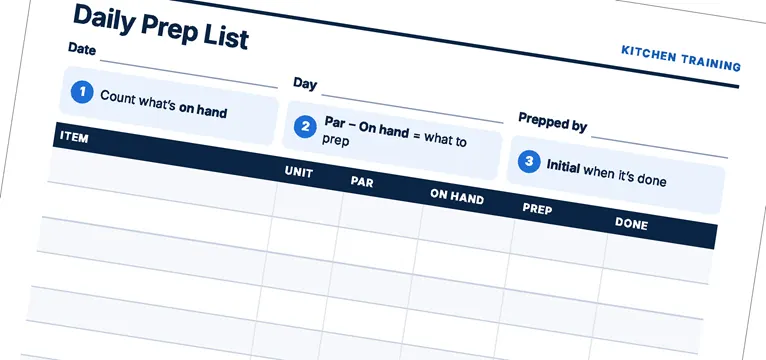
Step 4: Run the prep list every day
This is the five-minute part. Before prep starts:
- Count what’s on hand for each item.
- Par minus on hand = what to prep today.
- Write that number in the Prep column. If it’s zero or less, skip it.
- Cooks initial the item when it’s done.
Example: Friday par for pico is 6 qt. You have 2 qt on hand. Prep 4 qt.
Step 5: Adjust every week
Look at what got thrown out, and what ran out. Thrown out? Lower that par. Ran out? Raise it. Expect a busy holiday, a catering order or a local event? Raise the pars for that day only.
Five mistakes that break the system
- One par for every day. Your Tuesday and your Saturday aren’t the same.
- Pars nobody updates. A par set in July is wrong by October.
- Counting by eye. “About half a pan” is a guess. Count it.
- Prepping it all in the morning. Short-life items can be split into two smaller batches.
- No date labels. If it isn’t labeled, it doesn’t count as on hand. (FIFO: first in, first out.)
What it gets you
- Less waste. You prep what you’ll sell, not what you might.
- Fewer 86’s. You stop running out in the middle of the rush.
- A calmer morning. Cooks know exactly what to do without asking.
- Training made easy. A new prep cook can follow the sheet on day one.
Get the prep sheet
Download the one-page prep list and par sheet in English or Spanish, print it, and post it in the kitchen:
Run a kitchen? everything-foodservice is free for Sysco customers: training like this, plus the products and manufacturers behind your menu. Join free.